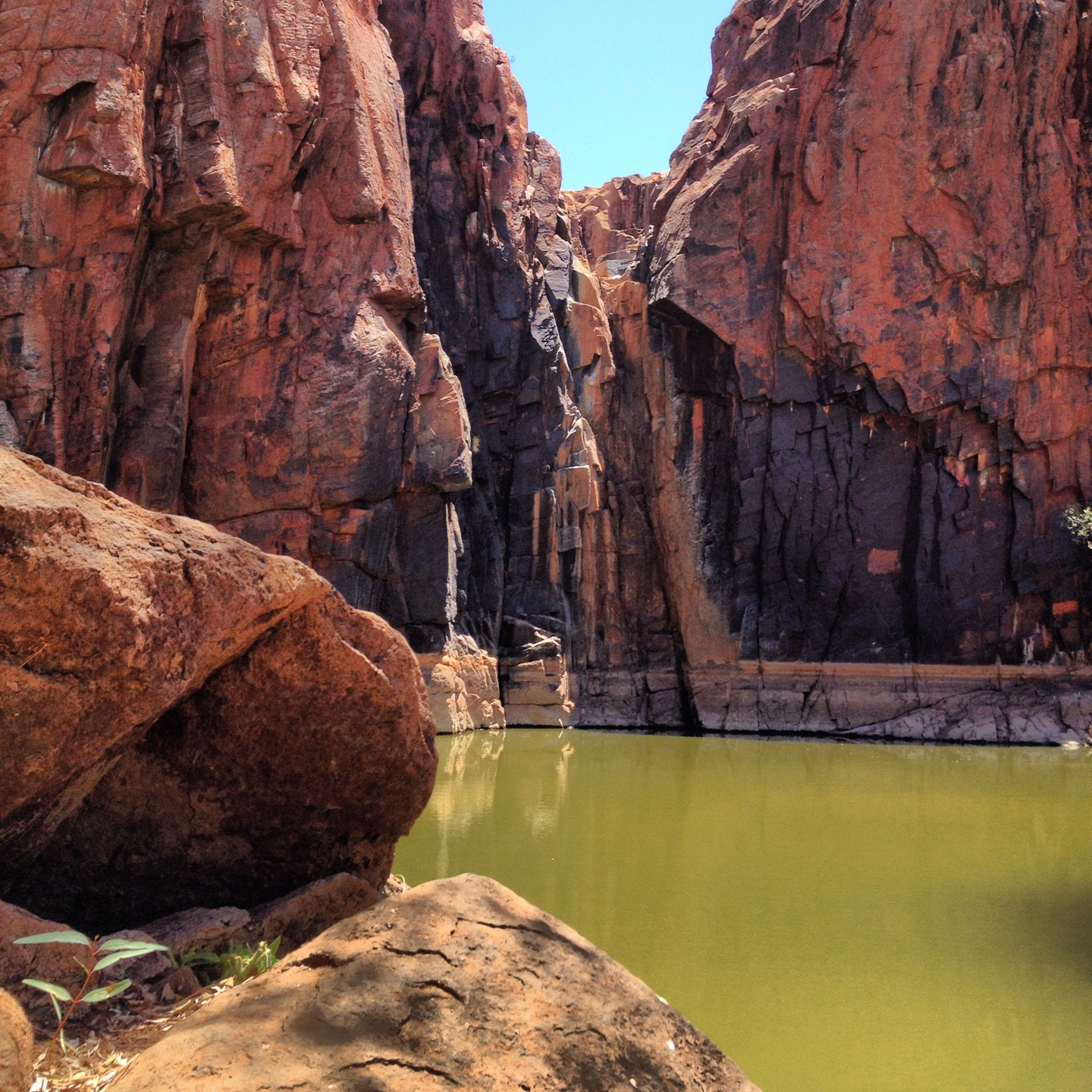
Lake Argyle


Lake Argyle, classed as an inland sea, is Australia's largest artificial lake. It is located near Kununurra in the north of Western Australia close to the Northern Territory border. The dam, completed in 1972, was designed to irrigate Kimberley's farmland. Its maximum storage capacity correlates to 40 times the size of Sydney Harbour over an area of ​​1000 sq km. Its creation was a disaster for the local Indigenous Australian communities whose lands were left submerged. However, it has also led to the emergence of a new ecosystem. Today, tens of thousands of crocodiles inhabit the lake and its artificial islands banks. Whether by boat or by plane, nature lovers will certainly enjoy the beautiful landscape of Lake Argyle!

The Flight Of A Lifetime


Don't have a 4WD to go to the Purnululu National Park?  You do not want to miss out on admiring this wonder of nature during your stay in the Kimberley but access to the park is closed? No problem, head to Kununurra and fly with Slingair Heliwork on a two hour scenic flight. You will remember it for the rest of your life! Every second of the flight is a feast for the eyes. After flying over the orchards of Kununurra, it is the beautiful scenery of Lake Argyle (photo) that is available to you. A few minutes later, the show becomes more amazing when the Bungle Bungle Range arises. The orange and black striped rock formations are also clearly visible from the air. Crevices, gorges, cliffs and creeks are part of the wide range of beauty that nature has to offer which you may not necessarily be able to access from the ground. The return to Kununurra is equally impressive especially over the Argyle Diamond Mine, the largest in the world. During the flight, the pilot is also your guide and provides valuable commentary on the region. The Bungle Bungle and Lake Argyle scenic flight is one of Slingair Heliwork's most popular. The company also offers a dozen more different flight options, either by plane or helicopter. A must to discover the hidden treasures of the Kimberley!

iPhoneography Oz was a guest of Slingair Heliwork.

Purnululu National Park


The Purnululu National Park offers one of the most fascinating landscapes on Earth, nothing less. From a geological, biological and climatic point of view, the Purnululu is unique in the world, which allowed it to be listed as UNESCO World Heritage site. Located in the Kimberley in Western Australia, it covers nearly 240,000 hectares. Its main attraction is formed by the Bungle Bungle Range, made of spectacular domed or hives rocks resulting from 20 million years of erosion. Some rise up over 200 metres above which look like small savannahs. The uniqueness of these formations also lies in their orange and black colored bands. On site one can find many hiking trails that run through winding and majestic gorges. Access to the park is not easy, due to its remoteness and track conditions (4WD required). It is possible to fly over the Purnululu departing from Kununurra. Please note that the park is closed during the wet season, from December to early April. As unlikely as it may seem, the Purnululu was discovered by Westerners around twenty years ago but the Indigenous Australians have long inhabited the area. One wonders how many places as magical as this are still unknown to the general public!

iPhoneography Oz was a guest of Department of Environment and Conservation (Western Australia).

Cable Beach


A trip to Broome would not be complete without seeing Cable Beach (and going to Matso's), long recognized as one of the world's best beaches. This long stretch of pristine white sand 22 kilometers is the ideal place to relax in the sun, take a swim, fish or just enjoy the beautiful sunsets over the Indian Ocean. Pay attention though, heading north on the west coast, Broome is one of the first places where jellyfish are reported.

Beer And Crocodile Meat In The Tropics


It is almost by chance that we crossed paths with Matso's Broome Brewery. What a great discovery! It is possible to visit this micro-brewery (under renovation during our stay) but you need to taste its beer and food. We are not necessarily big fans of beer but we could not resist the invitation. Be aware that they have a great selection. If like us, you can not make up your mind when faced the wide selection offered, opt for a tasting. You will receive five beers of your choice on a tray. After the tasting, our preference swayed towards the mango beer and the ginger beer. The chilli-out beer, a wheat beer with a bold chilli statement, is also standout. The terrace restaurant is located in a tropical atmosphere. But know that the exotic atmosphere is not only in the gardens around you, there is crocodile meat on the menu! If you're looking for an excuse to get to Broome, Matso's is a very good one!

iPhoneography Oz was a guest of Matso's Broome Brewery.

Broome, A Tidal Story


Broome is a small seaside town with a tropical climate which seems rather calm and without major attraction at first sight (though it must depend on the season). Of course, Broome hosts the world famous Cable Beach. But if you take the time to explore, you can also enjoy the rich cultural and historical heritage influenced by the ethnic diversity of the city which was once the World's capital of the pearl industry. As far as natural attractions go you will not be disappointed either. The tidal movements, among the largest in the world, offer visitors interesting natural phenomenons. First of all there is the famous Staircase to the Moon. This natural spectacle creates the optical illusion of a staircase reaching for the moon. It occurs three times a month between March and October at extremely low tide, when the full moon rises over the exposed mudflats. The low tides allow the visitors to discover Dutch Flying Boat Wrecks, the remnants of the Japanese air raid on Broome during World War II in March 1942. Finally, visiting the remarkable rocks at Gantheaume Point (photo), you step further back in history, because there are 130 million year old dinosaur footprints that can be seen at extremely low tide. One thing is certain, before traveling to Broome, it is important to check the tide schedule to not miss any part of the show!

Red!


Moving away from major Australian cities is driving mostly on sand tracks with all the surprises that await you at the next turn. Dust is one of many of these not so pleasant surprises. Desert regions are often very dry, which does not help the situation. It is difficult in these conditions to maintain a clean vehicle. But it does not deserve a post on iPhoneography Oz if we would stop here. Know that while driving, vehicles create so much fine dust that a large quantity seeps into cars, even with windows closed and fan off. In Western Australia, it is mainly the red dust that is on the menu. This is due to the presence of iron in the sand, the oxidation by the action of sunlight gives it this red color. One could almost believe to be at the French Open, on Roland Garros center court's clay. The good news is that it adds a little color to your interior and your complexion.

Eighty Mile Beach


Eighty Mile Beach, which technically equates to around 130 kilometres, stretches over 200 kilometres long and 100 metres wide in reality. This white sand beach of Western Australia is located between Port Hedland and Broome. The place is famous for its fishing, shell collecting and bird watching. Actually it seems that each year, half a million shorebirds come to rest and feed on the beach after migrating from the Arctic Circle. It is also a great place to watch the sunset over the Indian Ocean. The pleasures of the beach without being disturbed by any annoying neighbours!

Walking Through The Karijini


The Karijini National Park is one of the jewels of the Pilbara. Walking through the park, you will discover spectacular scenery that time has shaped for over two billion years. A paradise for geologists, but not only this. The water has carved out magnificent gorges, some of them hundreds of metres deep. It is possible to access waterholes (or admire them from various lookouts) after a short walk or longer hikes. You will not be disappointed! These gorge walks are also the main attraction of the place. The Karijini is located just above the Tropic of Capricorn and often the temperatures reach 40°C in summer. The ideal time to visit is between May and September. No matter when, you will certainly appreciate swimming in the creeks. It is a refreshing experience that contrasts with the arid surroundings. Access to the park by car is possible even if some roads are not sealed. Note that only the northern part of the park is accessible to the public. One wonders what the southern part has to offer. We want more!

iPhoneography Oz was a guest of Department of Environment and Conservation (Western Australia).

Road Conditions In Australia


Well, it is no big secret, but Australia is a vast country. As soon as one takes to the road, especially when traveling inland, the distances are huge and Australia becomes a dreamland for a road trip. Hazardous road conditions are common though so always be cautious. If the main roads linking the capitals and major cities are in excellent condition, most of the other roads are still unsealed and in a random condition. Thus in remote areas one can find roads ranging from asphalt to gravel and tracks. Many are feasible with a conventional vehicle, but in the more remote areas, the use of a 4WD is highly recommended and even mandatory in some places. It is important to check with local authorities before hitting the road. Of all the dangers of frequent road surface changes, the more annoying for passengers and more challenging for your car is probably found on corrugated roads. To give you an idea, imagine driving on corrugated iron for hundreds of kilometres in the middle of the outback. Unfortunately, it is difficult to prevent this from happening. However, it can be temporary solved by regrading the road (photo). Safe travels!

The Fascinating Landscapes Of The Pilbara


The Pilbara is a land of contrasts, rich with many natural wonders. Temperatures are generally high and the sky clear. During a stay in the area, take time to discover the fascinating landscapes of the national parks that time has taken millions of years to carve. Karijini National Park is the most popular of them, but some other parts of the region are also worth a look. This is the case with the Millstream Chichester National Park, which covers 200,000 hectares 150 kilometers south of Dampier. Cliffs and winding tree-lined rivers are spectacular. The park also hosts natural rock pools including the magnificent isolated Python Pool (photo). Beyond their beauty, these waters are also gifts of nature when you walk in temperatures exceeding 40°C. If you plan to spend time in the area, take precautions because there is no drinking water for hundreds of kilometres around.

The Legend Of Red Dog


We are in Western Australia's northwest. Back in the 70's the region was inhabited by various isolated mining communities. During this era, Red Dog, an iconic Australian Kelpie, spent his time wandering the land. His nickname has been attributed to the red dirt of the Pilbara. Over time, his travels made him a legend among the local population. Legend has it that after his master's death, he embarked on an endless search of him through the Australian outback. Along the way, through his unconditional companionship he united even the hardest of hearts in the local communties. The legend is perpetuated through poems and stories about the adventures of Red Dog. Recently an eponymous film, fast becoming one of the most successful Australian movies of all time, brought the legend of Red Dog to the big screen. It is a feel-good movie that will touch the hearts of everyone (watch the trailer). A memorial (photo) was erected by the many "friends" he made during his travels in honour of his contribution to the morale of the community. It is located at the entrance of Dampier, a city where he often returned.
Ironically, Red Dog could have been one of the last films that Loïc worked on the promotion of before starting the iPhoneography Oz adventure.

Cape Range National Park


Cape Range National Park is the terrestrial part of the Ningaloo Coast, a UNESCO World Heritage Site. The submerged part of the North West Cape has a diverse and abundant marine life with colourful underwater scenery, whereas the park is formed by rugged and arid land. Red limestone cliffs, incised by deep gorges, are impressive. In the eastern part of the park, a road located twenty kilometres south of Exmouth follows the razor-backed ridges and provides breathtaking views of the Charles Knife Canyons. One could easily believe they were in the Grand Canyon. There are several lookouts along the way that provide fantastic photo opportunities. Photographers and nature lovers may have found their paradise here. The western part of the park, meanwhile, gradually flattens out as it approaches the coast, giving way to the pristine white sand beaches of the Ningaloo Reef. Both the wildlife and the flora are very rich. That said, a visit in late winter is preferable to be sure to see the animals and wildflowers.

iPhoneography Oz was a guest of Department of Environment and Conservation (Western Australia).

Coral Viewing And Snorkelling Tours In Exmouth


In addition to our visit to Coral Bay, we joined a snorkelling tour in Exmouth. Like Coral Bay, Exmouth also offers the opportunity to snorkel on the Ningaloo Coast, a UNESCO World Heritage Site. We were delighted to join Ningaloo Ecology Cruises on their Glass Bottom Boat tour which allowed us to get up close and personal with the natural wonders of the reef. As you glide through the crystal clear water you can marvel at the colourful and 1,000 years old coral, swim with turtles and tropical fish. They offer a few different tour options ranging from coral viewing and snorkelling to exclusive tours that can be tailored to your needs. The moment you book with them the tour is guaranteed regardless of numbers. This is how much your hosts, Alek and Gina, love their "office"! It is easy to see why and we have no doubt that you will enjoy this cruise as much as we did!

iPhoneography Oz was a guest of Ningaloo Ecology Cruises.

Welcome To Exmouth


Exmouth is a small coastal town of 2,500 inhabitants located at the north end of the Ningaloo Coast. This small Western Australian town is a magnet for tourists from all around the world each year between April and July when they come to swim with the whale sharks. Its beaches and snorkeling sites are easily accessible throughout the year. Beyond the underwater wonders of the Ningaloo, note that Exmouth is a few minutes drive away from the grandiose landscape of the Cape Range National Park. Exmouth is also a communication base for the U.S. and Australian Navy and has been since the 60s. Better to have your own vehicle to explore the surroundings. Nature lovers are in heaven!

Fascinating Termite Mounds


Termite mounds, which can be seen very easily along the roads in northern Western Australia and Northern Territory, are quite a spectacular and natural phenomenon that reminds us of the anthills of New South Wales. The bush is filled with hundreds, if not thousands, of what often resembles a new form of Pinnacles. Neither form nor color are regular. These mounds can reach up to two meters high, especially in the Litchfield National Park. Inside, the complexity of the structure of these nests, allowing temperature control is equally fascinating.

Discover Coral Bay On A Quad Bike


Coral Bay activities are mainly ocean oriented, but there is an exception. Coral Bay Ecotours, in addition to its Whale Shark Tour, Marine Eco Tour and Glass Bottom Boat Tours, also offers Quad Bike adventures. It is ideal for exploring the pristine beaches, bush tracks and sand dunes unknown to most tourists. Whether it is to admire the sunset on the horizon or to see turtles from cliff tops feeding in shallow waters just metres from the shore, each tour available offers interaction with nature. From our side, we tried the Snorkel Sunset tour. The quads are automatic, thus very easy to drive. A very pleasant activity that we recommend you try!

iPhoneography Oz was a guest of Coral Bay Ecotours.

Snorkeling in Coral Bay


Coral Bay is a marine paradise on the Ningaloo Coast. With its coral reefs and underwater species that roam the seabed a few hundred metres away from the coast, it is the ideal place to practice snorkeling. Rather than go blindly, you can join a tour organized by local tour operators such as Coral Bay Ecotours whose Marine Ecotour is an activity not to be missed (and we have not missed it!). Slip into your wetsuit, mask and snorkel and throw yourself into the water once your guides give you the green light. The coral reef is amazing. Approach and see hundreds of fish and turtles that evolve in their natural environment, it is something really magical. But this is nothing compared to the experience that awaits you later on this tour when you come to swim with the largest ray on Earth: the manta ray. Unlike whale sharks, manta rays are present on the reef all year round. Beyond this unique experience, this adventure lasts for a period of five to six hours and also includes the loan of all equipment, a hearty snack and refreshments. You will be blown away!

iPhoneography Oz was a guest of Coral Bay Ecotours.

Take A Rest In Coral Bay


Located at the southern end of the Ningaloo Coast, Coral Bay and looks like a huge camping ground. This small-scale community is really relaxed. It is also one of Western Australia's premier family holiday destinations. One can walk easily around town and the schedule type of each visitor alternates between lazing on the magnificent pristine white beach of the bay, snorkelling around the coral reef or taking part in the various activities offered by local tour operators. We loved it and we ended up staying two days longer than originally planned.

Ningaloo Coast


Here is a new found love of exceptional beauty! Ningaloo Coast, recognized as one of the last great ocean paradises, stretches 300 kilometers between Shark Bay and Exmouth. From the shore, the banks offer dreamy scenery. Under water, where the colour could not be more perfect (photo), there are a multitude of marine species including barracudas, dolphins, dugongs, manta rays, sharks and turtles. The region is also famous for hosting 300-500 whale sharks each year, the largest fish in the world. Between March and July, visitors from around the world flock to the Ningaloo Coast for the experience of a lifetime: a swim with whale sharks. This is the only place in the world where these giants of the sea are easily accessible and are returning in large numbers near the coast with the precision of a Swiss watch. Unfortunately we missed it because we were in the area out of season. Finally, the Ningaloo Coast is also famous for its world class reef composed of not less than 300 coral species, over 700 species of reef fish (including Nemo), about 650 species of molluscs, nearly 600 species of crustaceans and more than 1000 species of seaweed. A mask and snorkel are enough to observe all this at only a hundred metres away from the shore! For all these reasons, the Ningaloo Coast in 2011 became the 19th Australian site to be inscribed on the World Heritage List of UNESCO.