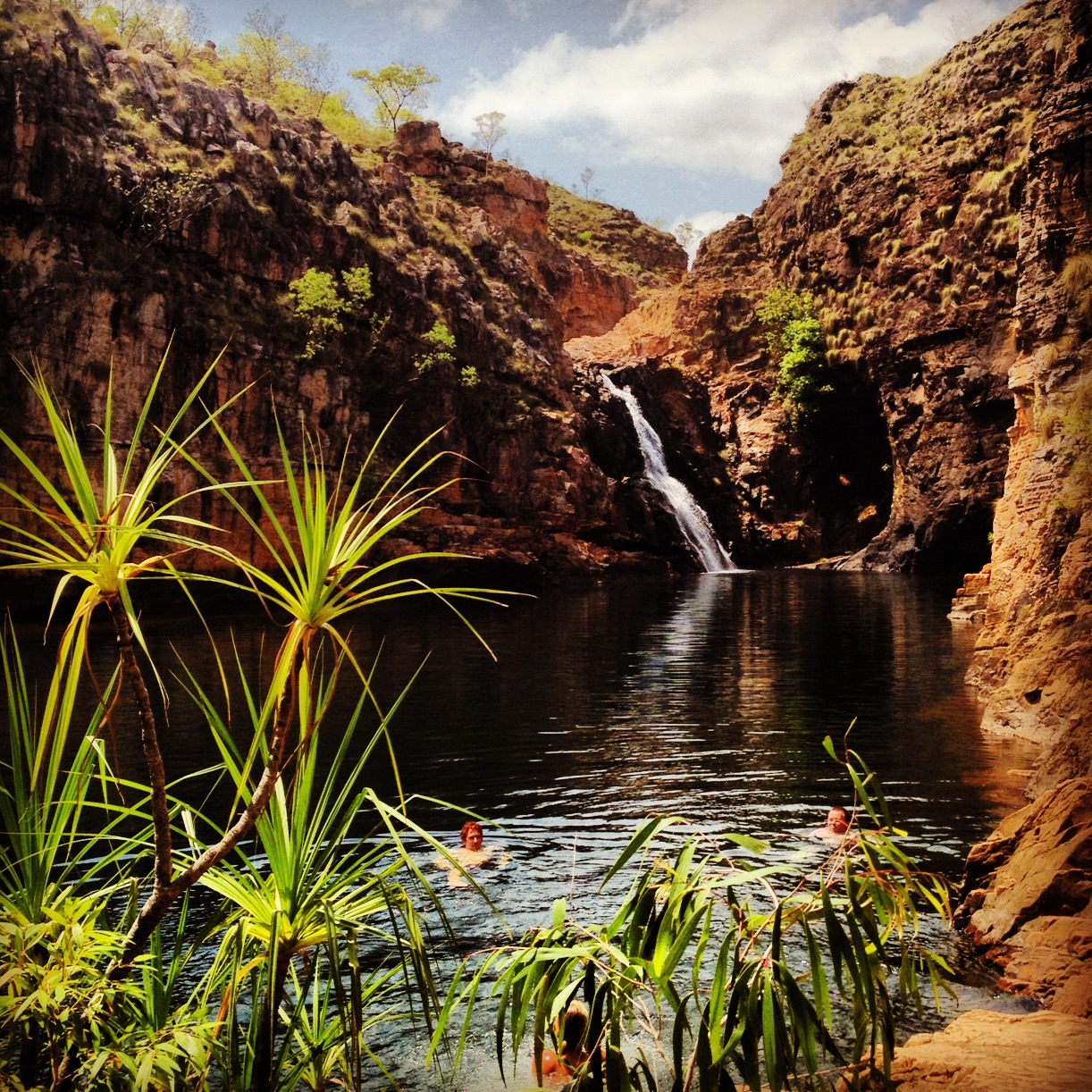
Kakadu National Park Looking Spectacular In The Wet Season


Every week, iPhoneography Oz invites one of its Instagram followers to cover a topic about Australian society. Today, meet @kaminipal. She posted this photo of the Kakadu National Park looking spectacular in the Wet Season.

iPhoneography Oz: Who are you in less than 140 characters?
kaminipal: Wanderlust, Scientist, Photographer.

iOz: Your photo from the Top End is fantastic. How would you describe the Kakadu National Park?
k: It's breathtakingly beautiful! The landscape, nature, fauna and flora is serene and captivating. You really get to see the true beauty that Australia has to offer in such places.

iOz: How much time should one spend in the area to be sure not to miss a thing?
k: It depends what you would like to do. The Top End has a lot to offer if you like nature. They have some great National Parks like the Kakadu. I think a week to two weeks on a road trip would be sufficient to touch base with a few of these places and take in the beauty the Northern Territory has to offer.

iOz: If you were stuck in Australia with an unlimited budget and a week in front of you, what would you do?
k: The Kimberley and Broome are on my next places to hit in Oz. I love nature so I would love to take in the most of by going to Karijini National Park, Bungle Bungle Range, watch the sunset over Cable Beach, see the Staircase to the Moon at Roebuck Bay and of course with a unlimited budget I'd love to go swimming with the whale sharks out at Ningaloo Reef. Could only imagine the amazing pictures from such a adventure!

iOz: What was one of the best travel experiences you've ever had in Australia?
k: Yes, the trip to the Top End was certainly one of the best I've had in Australia. I really wanted to see the true Australian outback, the true beauty of the outback and it gave me that opportunity.

iOz: What's your favourite photo on the blog?
k: Love the collection of photos from Coral Bay in Western Australia, snorkelling and ped biking.

iOz: What kind of photos can our readers see on @kaminipal's Instagram feed?
k: My instagram feed is photos of my life, experiences and travel adventures. The world through my eyes.

iOz: What will you be doing for the next hour?
k: Heading back to Sydney from a weekend of adventure at Jenolan Caves.

iOz: We're switching roles, ask us anything!
k: What motivated you to start a photography blog of Australia?
iOz: The desire to share our adventures and show Australia through a perspective that differs from traditional guide books or travel blogs.

iOz: A last word?
k: "There is only you and your camera. The limitations in your photography are in yourself, for what we see is what we are." -Ernst Haas

Photo captured by @kaminipal. To be featured, follow @iPhoneographyOz and tag your own iPhone photos with #iOz. Any image taken in Australia and tagged with #iOz is eligible.

Kata Tjuta, The Other Uluru


Kata Tjuta (Mount Olga) is less known than its famous neighbor Uluru, but it is still impressive. These domes (there are 36 exactly) are located about thirty kilometres away from the rock of Uluru. They are part, with the latter, of the Uluru-Kata Tjuta National Park, a UNESCO World Heritage Site. We urge you to walk within the valleys and deep gorges created by these rock formations. Whether you choose the Valley of the Winds (7.4 km), or in the Walpa Gorge (2.6 km) (photo), do not miss this opportunity to get away from everyone and everything in a breathtaking environment. You will certainly feel alive! The colors are particularly beautiful in the afternoon and early evening. Be careful though, because of the extreme temperatures which often occur in the area, the tracks are not always open to the public. They are closed when the temperature exceeds 36°C. The picnic area located a few kilometers away from the base of Kata Tjuta, however, is a good alternative to admire the sunset.

Uluru, The Sacred Place


Uluru is one of the most famous rocks in the world (photo). Also known as Ayers Rock, this world-class natural show is particularly moving, an emotion difficult to express with words. No photo or video can replace what you see with your own eyes after the long journey that takes you there (Alice Springs is 460 km away, Adelaide is 1,600 km away and Darwin is 1,960 km away). It is located in the Uluru-Kata Tjuta National Park, which also includes the rock formations of Kata Tjuta (Mount Olga), sacred places of a very high importance to the Anangu people, one of the oldest human societies in the world. The park is one of the few sites part of the UNESCO World Heritage List for both its natural and cultural wealth. Uluru, which has become a major tourist attraction since the World War II, is a symbol of Australia. With the construction of a huge modern resort and the presence of too many tours, the place loses its authenticity. Sometimes it feels like Disneyland and that is unfortunate. Just like us, you can do your part not to encourage this excessive commercial development:
  • Do not climb Uluru, you will show respect to Traditional Owners' law and culture;
  • Take part in a daily cultural guided tour, run either by the Rangers (free) or by Indigenous;
  • Visit the impressive Cultural Centre (free);
  • Spend the night, if possible, on one of the free campsites located around the park.
Finally, do not miss a sunset over Uluru. This is a unique moment when the rock changes colors. Note that raining is rare in the Outback. However, severe storms can occur at Uluru. On this occasion, you might see a rare sight: huge waterfalls. If you have had the chance to experience it, share your photos with our readers!

Extreme Heat In Australia


We are not going to lie: summer in Australia is warm, sometimes really hot. Whether on the road that took us from Perth to Darwin or traveling from Darwin to Adelaide, we had days where the temperature never came down below 40°C: a true desert climate! Heading towards the center, precipitation is low, which makes the heat difficult to bear. The highest temperature we experienced was 46°C (photo) in Tennant Creek.

Unique Stopover On The Stuart Highway


A few weeks ago we came accross the William Creek Hotel and the North Star Hotel in South Australia. This time, on the Stuart Highway between Katherine and Tennant Creek, we spotted the Larrimah Hotel, in the tiny hamlet of the same name. As for the other two, you have to stop in this pub. You will have no problem to recognize it: the Pink Panther is sitting outside along the highway. The Larrimah Hotel is a hotel, a camping, a pub, a museum, a zoo... but also one of the many unusual places that give the Outback part of its charm. There are certainly dozens of them scattered around the country. Feel free to share your own discoveries with us!

Swimming Bliss


What a delight to swim in these thermal pools found scattered across the Northern Territory (and the rest of northern Australia)! We mentionned Katherine's Hot Springs a few days ago. This time, we are at the Bitter Springs in Mataranka. They are located in a beautiful environment on the edge of Elsey National Park, 100 kilometers south-east of Katherine. These spring-fed thermal pools are a great place to relax amongst palms and tropical woodlands, especially after a long drive. We even came accross a European couple riding their bikes around the world, who spent the night there. Still be carefull though. Swimming is not permitted during the wet season due to dangerous currents and increased risk of Saltwater Crocodiles.

Crocodile Hunting


One of the major tourist attractions in Darwin area is undoubtedly joining a "hunt" for crocodiles. Of course, there is the Crocosaurus Cove. But to see these reptiles in the wild, you need to head out from the city centre and join a boat cruise on the Adelaide River, well know for its high concentration of Saltwater Crocodiles. There are, in total, more than 100,000 reptiles of this species in the northern Australia's rivers. However, it is actually really rare to see them. On the Adelaide River, they are used to the boats and they know that they will be fed, so they do not hesitate to leave their place of hiding. Even if we are on a boat (read "relatively safe"), it is still pretty impressive to see them approaching. When close to the piece of meat waiting for them, they do not hesitate to jump out of the water (photo), showing visitors their incredible power. There are many cruises available. We experienced the activity offered by Spectacular Jumping Crocodile Cruise which claims to have the most experienced staff on the river. This is one of the most exciting activity we have done so far. This cruise, which lasts for about an hour, is to put on your To-Do List right away!

iPhoneography Oz was a guest of Spectacular Jumping Crocodile Cruise.

Crocs In The City


Lately in a few Northern Territory parks, we have seen many signs indicating the presence of crocodiles. Fortunately, our last encounter with one of these reptiles, which was in March, occurred at Wild Life Zoo in Sydney. Being in Darwin, we did not want to miss a visit to Crocosaurus Cove in the heart of the city. This centre dedicated to these fascinating creatures is above all a rare opportunity to get really close to them. The Big Croc Feed is a not to be missed attraction. Considering that Crocosaurus Cove is home to some of the world's largest crocodiles in captivity, it is quite an awesome show! If you feel like it (and you should do it no matter what), you can also fish for energetic juvenile crocodiles. The Cage of Death, Australia's only crocodile dive experience, is accessible at an extra fee (we did not experience it, but no doubt it must be as impressive as diving among Great White Sharks). Photo opportunities guaranteed!

iPhoneography Oz was a guest of Crocosaurus Cove.

Darwin, The Remote Capital


Darwin surroundings are not to be missed, either Kakadu or Katherine region, but the city itself is rather disappointing. This is at least the case if you expect to arrive in a bustling tourist destination. It must be said that the capital city of Northern Territory has not always lived happy days. During World War II, the city has indeed suffered many attacks from the Imperial Japanese Navy Air Service. Numerous civilians were killed and extensive damages were caused to the town. A few years later, in 1974, Cyclone Tracy destroyed a massive part of the city. Darwin is also known to be the most lightning-prone city in the world. The picture is not really rosy if we add to all of this, accidents caused by crocodiles, presence of jellyfish in the Timor Sea and the remoteness of the city (Darwin is closer to the capitals of five other countries than to Canberra). Fortunately, there are still some activities of interest. Lameroo beach (photo), located under the Esplanade, is not exposed to the public. This is a great place to watch the sunsets. A few steps away is Mitchell Street, the bustling part of the city. This is where one can find many bars and restaurants as well as the Crocosaurus Cove, a must see attraction when visiting Darwin dedicated to the crocodiles.

Kakadu National Park


Kakadu National Park is a reserve of major importance, both for its natural and cultural treasures (its lands have always been inhabited for more than 40,000 years). UNESCO has also listed Kakadu as World Heritage in both categories. Covering an area of 20,000 sq km, it represents a complex ecosystem in which a surprisingly large amount of rare plant and animal species live together, just over two hours drive from Darwin. We did not spend to much time there but we still had the chance to discover beautiful places such as Maguk (photo). Do not make the mistake to spend too little time in the Park. There are many tour operators in the area. Joining a guided tour is probably the best way not to miss any of all its treasures, including Aboriginal rock paintings, in one of the world's largest concentrations. Note that the entrance is free. Jabiru, a small town completely surrounded by Kakadu National Park is really handy for refueling (visitors and vehicles).

On The Way To Darwin


Edith Falls (or Leliyn) are the second main attraction of Nitmiluk National Park along with the Katherine Gorge. These picturesque waterfalls flow into a massive plunge pool in which it is possible (and very pleasant) to swim. Be careful though because signs indicate the possible presence of freshwater crocodiles, considered less dangerous than saltwater crocodiles, in the late afternoon. This beautiful place is located on the west side of the Park, 40 kilometres north of Katherine on the Stuart Highway on the way to Darwin. Leliyn has a landscaped campground with unpowered sites.

The Spectacular Katherine Gorge


During a stay in Darwin do not miss the opportunity to visit the world famous Katherine Gorge, located in the Nitmiluk National Park, 250 kilometres south of the capital city of the Northern Territory. This deep gorge, more than 20 million years old, offers a diverse and spectacular landscape, including cliffs over 70 metres high (photo). The most popular place to admire the surroundings is located directly on the Katherine River (cruises, canoeing, swimming). It is also possible to walk on one of the numerous walking tracks starting from Nitmiluk Centre to experience the gorge from above. Access to Katherine Gorge is via Katherine on a 30 kilometres sealed road northeast of the city. It is better to avoid visiting the park during the wet season (December to April). Due to flooding, access and activities are not necessarily available. The best time to visit the park is therefore between May and September.

Why Katherine Is Worth A Stop


The small town of Katherine is located 300 kilometers south of Darwin. It is well known to tourists because of its proximity to the Nitmiluk National Park, home of Katherine Gorge and Edith Falls. Katherine is also the birthplace of Cadel Evans, 2009 UCI Road World Champion and the first Australian to win the Tour de France in 2011. Many deny the existence of its Hot Springs (photo), however, they are a natural curiosity and certainly worth a stop in Northern Territory's fourth largest town. Beyond a natural swimming pool, it is a real jacuzzi. The crystal clear water in this spring has an average annual temperature of 32°C. The place is not necessarily well signposted. It lies between the Victoria Highway and the Katherine River about a kilometre south of the city centre. The enchanting landscape and the recent restructure of the area make it a really pleasant place. A must do!

Crocodile Safety


Spiders, sharks are snakes are just a few among the plethra of dangerous animals in Australia. In the north of the country, whether in Western Australia, Queensland or the Northern Territory, crocodiles are high on the list too, especially considering they are top of the food chain and humans are on the menu! They can be found almost anywhere there is water, in rivers, along coastlines, estuaries and even bodies of water that lie far inland. Admittedly, the creeks are beautiful and inviting, especially when it is hot. But before a swim, take the time to read the warning signs! One also wonders what important information has been hidden on this sign that was found in the Kakadu National Park.

Bushfires In Australia


In the north of Western Australia and the Northern Territory, bushfires are common throughout the year. It is important to take precautions when staying in the area. These fires have killed in the past. If you are travelling or if you camp in a forest or the bush, fire is a potential hazard that should not be overlooked. Authorities make travellers guides available for visitors to understand the risks and to know how to react if a fire starts.

The Australian Baobabs


Found in the Kimberley and in the adjacent Northern Territory a multitude of Australian baobabs. This is the only place in Australia, and one of the few places in the world (there are other species in Africa, Arabian Peninsula and Madagascar), where one can see these interesting trees growing natively. Like all the baobabs, they are easily recognizable by their impressive trunk size. Indigenous Australians used them as a food source and for medicinal purposes. They also used them to paint or make sculptures. On the other hand tourists stop on the side of the road to take pictures of them, as they do with the termite mounds that are also found in large numbers in the area.